

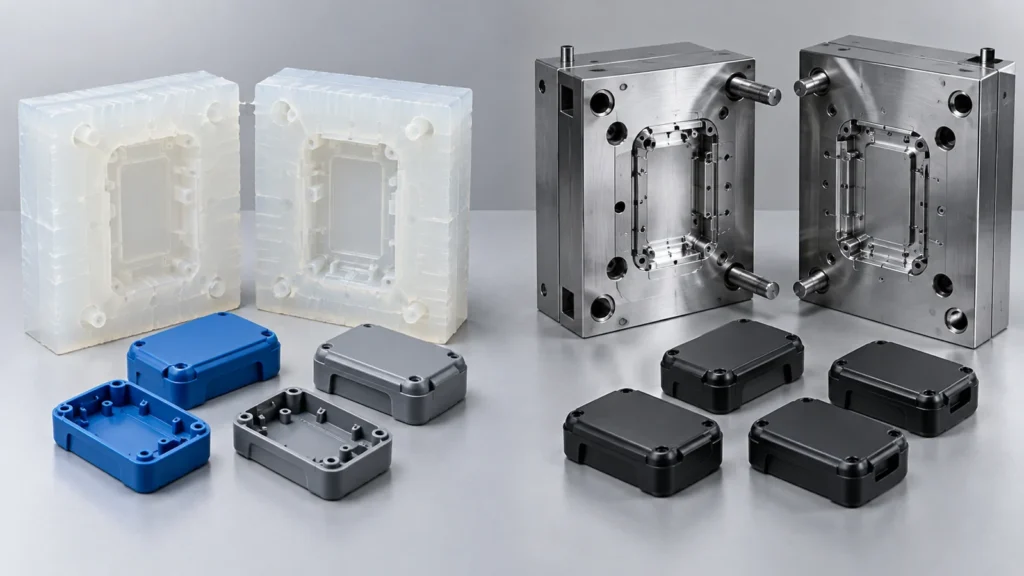
Vacuum Casting vs Injection Molding: Cost, Quality and Volume
Short answer: vacuum casting is usually the practical choice when a project needs a small batch of realistic prototype parts without investing in a production mold. Injection molding becomes more economical when demand is stable, quantities are higher, and the same geometry will be produced repeatedly. The right process depends on total program cost, material requirements, part design, lead time, and how much design change is still expected.
This guide compares vacuum casting and injection molding from an engineering and purchasing perspective. It is intended to help product teams choose a process before requesting a manufacturing quotation.
Vacuum Casting vs Injection Molding at a Glance
| Decision factor | Vacuum casting | Injection molding |
|---|---|---|
| Tool type | Flexible silicone mold made from a master pattern | Machined metal production mold |
| Best production stage | Functional prototypes, pilot runs, bridge production | Repeat production and stable product demand |
| Typical economic volume | Tens of parts per design or mold set | Hundreds to thousands of parts and beyond |
| Initial tooling investment | Lower | Higher |
| Unit cost as volume increases | Relatively stable and labor-dependent | Falls significantly after tooling is amortized |
| Design-change flexibility | High; a revised master and silicone mold can be produced | Lower; mold changes can require machining and validation |
| Material choice | Polyurethane casting systems that simulate common plastics | Production-grade thermoplastics and engineered resins |
| Surface detail | Replicates the master pattern closely | Controlled by the mold surface and molding conditions |
| Repeatability | Good for prototype and short-run requirements | Better for long production runs and tighter process control |
What Is Vacuum Casting?
Vacuum casting, also called urethane casting, starts with a high-quality master pattern. The master can be produced by CNC machining or a suitable 3D printing process, then finished to represent the desired surface. Liquid silicone is poured around the master and cured. After the master is removed, the resulting flexible mold is used to cast polyurethane resin under vacuum.
The vacuum reduces trapped air and helps the resin reproduce small features and surface details. Because silicone tooling is faster and less expensive to prepare than a metal injection mold, the process is useful when the design may still change or when the required quantity does not justify hard tooling.
Vacuum casting works well for:
- Appearance models and customer-review samples
- Functional prototypes that need plastic-like behavior
- Pilot builds for assembly and fit testing
- Marketing samples before production tooling is complete
- Short runs with several color or hardness variations
- Bridge production while an injection mold is being manufactured
The main limitation is mold life. A silicone mold gradually changes as it is exposed to heat, resin, demolding forces, and complex undercuts. Mold life therefore depends on geometry, resin, surface texture, and acceptance criteria rather than a universal shot count.
What Is Injection Molding?
Injection molding melts thermoplastic pellets and injects the material into a closed metal mold under pressure. Once the plastic cools and solidifies, the mold opens and ejects the part. A properly designed tool can support repeatable production with short cycle times.
The production mold requires more engineering and machining than a silicone mold. Gate location, cooling, venting, shrinkage, draft, ejection, and parting-line decisions must be resolved before production. This raises initial cost and lead time, but the investment can produce a much lower unit cost when the expected volume is high enough.
Injection molding works well for:
- Stable designs moving into repeat production
- Programs requiring production thermoplastics
- Parts with molded ribs, bosses, clips, and other integrated features
- Projects that require consistent dimensions over many cycles
- Products with ongoing demand and predictable annual volume
- Applications where production material certifications are required
Seven Factors That Determine the Better Process
1. Total program cost, not only unit price
A useful comparison separates tooling cost from part cost. Vacuum casting usually has a lower tooling entry point, but each casting involves material preparation, mold handling, curing, demolding, and finishing. Injection molding has a higher tooling entry point, while its automated cycle can reduce the part cost at larger quantities.
Instead of asking which process has the lowest unit price, compare the total cost at the quantity you actually expect to purchase:
Total program cost = tooling + validation + part production + finishing + inspection + expected design changes.
If a design is likely to change after user testing, include the cost of that change. A low initial injection-mold quotation can become expensive if major geometry revisions require tool rework.
2. Required quantity and demand certainty
Vacuum casting is attractive for small batches because the tooling cost is distributed across relatively few parts. Injection molding becomes attractive as volume increases and its metal tool is amortized across more units. The crossover point is project-specific. Part size, cavity count, resin, tooling material, cosmetic requirements, and inspection all affect it.
Demand certainty matters as much as quantity. A forecast of several thousand parts does not always justify hard tooling if the design, market, or regulatory requirements are still changing. In that case, a staged approach can reduce risk.
3. Lead time and development stage
Vacuum casting can move quickly after the master pattern is approved. It is therefore suitable for design reviews, field trials, exhibition samples, and pilot assembly. Injection molding takes longer before the first molded sample because the tool must be designed, manufactured, assembled, and sampled.
Once the injection process is stable, however, it can produce parts much faster per cycle. Teams should distinguish time to first acceptable part from time to complete the whole order.
4. Material performance
Vacuum-cast polyurethane systems can simulate characteristics such as rigidity, impact resistance, flexibility, transparency, or heat resistance. They are useful for evaluating form, fit, handling, and many functional requirements, but they are not chemically identical to production thermoplastics.
Injection molding supports a wider selection of production-grade thermoplastics, including reinforced and application-specific grades. When long-term aging, chemical compatibility, sterilization, flame rating, or regulatory approval depends on an exact resin, injection molding may be required for final validation.
5. Geometry, draft, and undercuts
The flexibility of silicone tooling allows some undercuts to be demolded without mechanical slides. This can make vacuum casting helpful during prototype development. Deep features, fragile details, thick sections, and aggressive undercuts can still shorten mold life or damage parts during removal.
Injection molding can manufacture complex geometry at scale, but the part must be designed for repeatable filling, cooling, and ejection. Draft angles, uniform wall thickness, supported ribs and bosses, sensible parting lines, and suitable gate locations reduce defects and tooling complexity.
6. Tolerance and repeatability
Both processes can produce accurate parts when the design and process are well controlled. Injection molding generally offers stronger repeatability over long runs. Vacuum casting accuracy depends on the master pattern, silicone-tool condition, resin shrinkage, cure conditions, and part geometry.
Do not apply the tightest tolerance to every feature. Identify critical-to-function dimensions on the drawing, define how they will be measured, and allow practical tolerances elsewhere. This improves quotation accuracy for either process.
7. Cosmetic finish and color
Vacuum casting reproduces the surface of the master, so the master-finishing stage is critical. Color can be mixed into the casting resin, and painting or other secondary finishing can be applied when needed. Small differences between batches should be considered when exact color matching is important.
Injection-molded finish is controlled by the mold surface, material, colorant, and process settings. It is normally the stronger choice for repeatable cosmetic production after the tool and color standard have been approved.
A Practical Cost Comparison Method
For an accurate comparison, request quotations at more than one quantity. For example, ask suppliers to price the prototype batch, the expected launch quantity, and the estimated annual quantity. Include the same drawing, material intent, finish, inspection level, and delivery requirements in each request.
| Information to provide | Why it matters |
|---|---|
| 3D CAD file and revision | Defines geometry and prevents quotation against an obsolete model |
| 2D drawing with critical tolerances | Identifies inspection requirements and special features |
| Prototype and annual quantities | Allows comparison of tooling and unit-cost economics |
| Material requirement | Determines whether a simulated polyurethane or exact thermoplastic is needed |
| Color and surface specification | Affects master finishing, mold texture, painting, and approval samples |
| Functional environment | Reveals temperature, load, chemical, UV, or regulatory requirements |
| Expected design changes | Helps select flexible prototype tooling or production tooling |
When Should You Choose Vacuum Casting?
- You need a small number of realistic plastic prototypes.
- The design may change after testing or customer feedback.
- You need multiple colors, appearances, or material simulations.
- Low initial tooling investment is more important than the lowest high-volume unit cost.
- You need bridge parts before production tooling is ready.
When Should You Choose Injection Molding?
- The design is stable and ready for production validation.
- You expect repeat orders or higher annual volume.
- The application requires a specific production thermoplastic.
- Long-run dimensional repeatability is essential.
- The tooling investment can be amortized across sufficient demand.
Using Both Processes in One Product Launch
The decision does not have to be permanent. A common risk-reduction path begins with rapid prototyping for early geometry checks, moves to vacuum casting for functional and cosmetic pilot parts, and then transitions to injection molding after the design and demand are stable.
This staged approach gives engineering, marketing, assembly, and quality teams physical parts earlier. It also provides an opportunity to correct drawings, interfaces, labeling, packaging, and inspection methods before committing to production tooling.
Design Checklist Before Requesting a Quote
- Confirm the current CAD revision and drawing revision match.
- Identify critical dimensions instead of tightening every tolerance.
- State whether the specified material is mandatory or performance-based.
- Define color using a recognized reference when visual matching matters.
- Mark cosmetic surfaces and acceptable gate, parting-line, or witness locations.
- Provide prototype quantity, launch quantity, and expected annual demand.
- Describe testing conditions, including load, temperature, chemicals, and UV exposure.
- Ask whether geometry changes could reduce tooling cost or manufacturing risk.
Häufig gestellte Fragen
Is vacuum casting the same as vacuum forming?
No. Vacuum casting uses liquid resin and a silicone mold to reproduce a master pattern. Vacuum forming heats a thermoplastic sheet and draws it over a tool. The equipment, materials, geometry, and applications are different.
Can vacuum-cast parts be used for functional testing?
Yes, when the selected polyurethane system represents the required mechanical and environmental behavior closely enough for the test. For final certification or long-term validation, confirm whether the exact production material is required.
How many parts can one silicone mold produce?
There is no fixed number. Mold life depends on the resin, geometry, texture, undercuts, cure temperature, and quality requirements. A manufacturer should review the model before estimating mold life and the number of molds required.
At what quantity does injection molding become cheaper?
The crossover quantity varies by project. Compare total cost at several quantities rather than relying on a universal threshold. Tool complexity, part size, resin, cavities, finishing, inspection, and expected design changes all influence the result.
Can vacuum casting be used before injection molding?
Yes. It can provide pilot parts for fit, assembly, appearance, packaging, and customer testing while the injection mold is being designed or manufactured.
Choose the Process Around Your Program Risk
Vacuum casting minimizes early tooling commitment and supports fast design learning. Injection molding rewards stable designs and repeat demand with scalable production economics. The most reliable decision comes from reviewing the CAD model, functional requirements, quantities, and future changes together.
Request a project-specific manufacturing review and quotation from Xproto.