

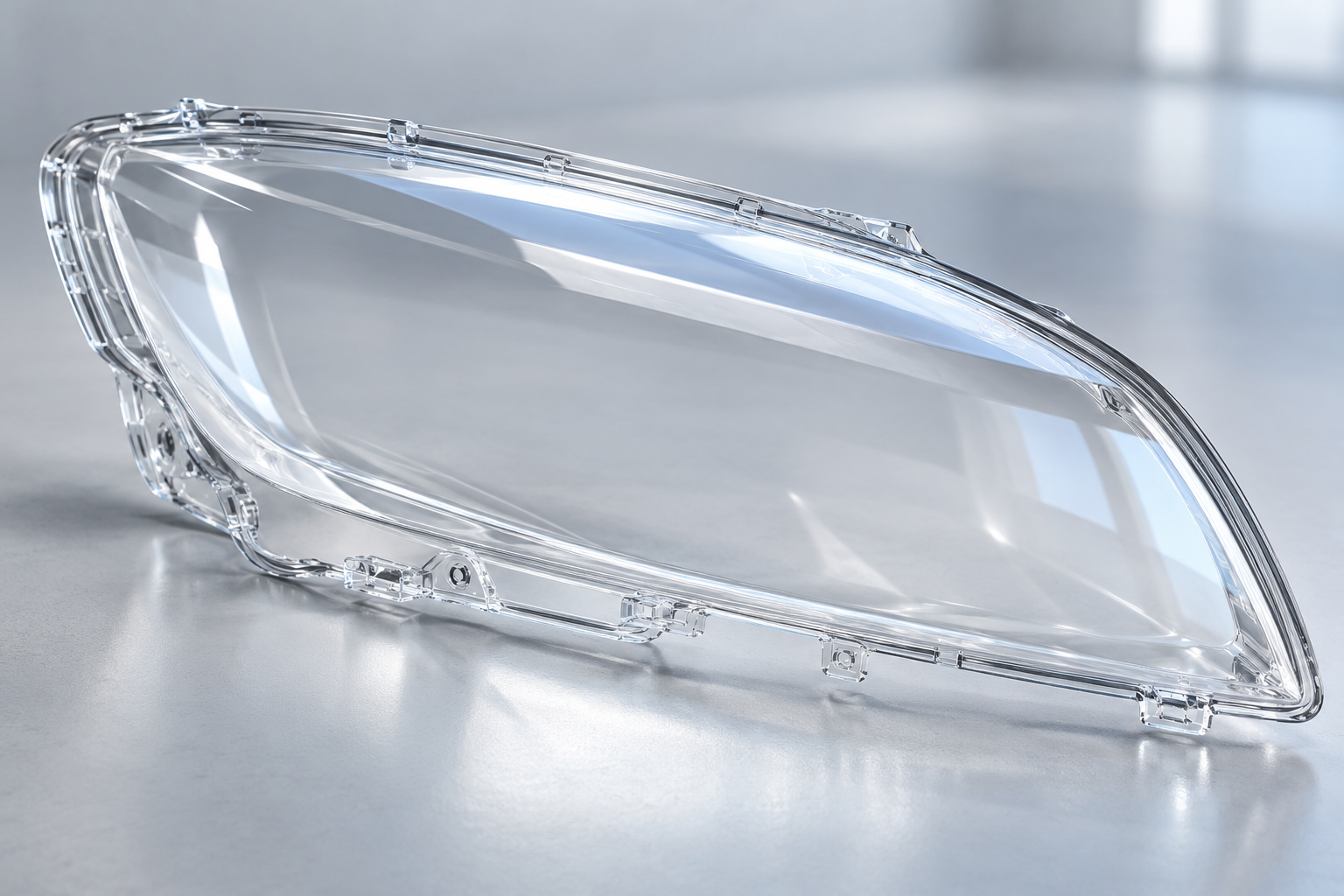
A clear UV coating for headlights is a transparent protective finish designed to help reduce sunlight-related damage to a plastic lens. The coating must suit the substrate and preserve the lens’s optical function. A glossy surface alone does not prove UV protection.
Xproto provides UV-protective coating surface treatment for automotive lamp covers. This guide explains what the finish does, how it differs from UV curing, and what to check before specifying it for a headlight lens.
Image: illustrative headlight lens cover, not a customer project or coating performance test.
What Does Clear UV Mean for a Headlight Lens?
In this application, the term means a clear finish with UV-protective performance. It is not a single coating chemistry or a universal specification.
A headlight lens faces sunlight, moisture, cleaning agents, and abrasion. A suitable coating system can help protect the plastic while retaining a transparent appearance. Its performance depends on the formulation, substrate, preparation, application, and cure.
For sourcing, use the fuller description UV-resistant clear coat for headlights. This identifies the intended function more clearly than “clear coat” alone.
UV Resistant and UV Cured Are Different
UV resistance describes performance: how well the coated lens withstands ultraviolet exposure under defined conditions.
UV curing describes a process: using ultraviolet energy to cure a suitable coating. Other systems use thermal curing or different cure mechanisms.
A UV-cured product does not automatically provide outdoor UV protection. Likewise, a thermally cured coating may offer UV resistance. Confirm both the protective function and the curing method rather than treating the words as interchangeable.
Why Plastic Headlight Covers Need Protection
Many automotive headlight outer lenses use polycarbonate because it supports complex shapes and impact-resistant designs. Without suitable surface protection, the plastic can suffer from weathering, scratches, and chemical attack.
Yellowing, haze, and surface damage are separate issues. Yellowing changes color; haze scatters light. A lens can look glossy yet still have poor clarity or a weakened coating.
Polishing can improve appearance, but it does not by itself establish durable UV resistance. On an existing lens, inspect the remaining coating and substrate before deciding whether recoating is appropriate. Cracks or deep damage may require a different solution.
Matching the Coating to the Plastic
Start with the exact resin grade, not simply “clear plastic.” Polycarbonate, acrylic (PMMA), and other transparent materials do not have identical heat or chemical tolerance.
A coating suitable for one substrate may cause poor adhesion, cracking, or distortion on another. Cleaning agents, primers, and cure conditions also need review. Validate unfamiliar combinations on representative samples before coating valuable finished parts.
For molded covers, disclose mold-release agents and prior treatments. For machined or polished prototypes, describe the surface condition and finishing history. The same coating can behave differently on different starting surfaces.
What a Good Specification Should Include
- Optical quality: Define visible defects, haze, color change, and light-transmission requirements where relevant.
- Weathering resistance: Agree on exposure conditions and acceptance limits, including the condition after testing.
- Adhesion: Evaluate the bond to the actual substrate, including after relevant environmental exposure.
- Abrasion and chemical resistance: Define the test method and expected cleaners or other chemicals.
- Coating thickness and coverage: Specify the approved system’s requirements and critical inspection locations.
- Masking: Identify bonding faces, sealing lands, fits, and other areas that must remain uncoated.
These are evaluation categories, not claims that every coating passes every test. Agree on methods, sample preparation, and limits before comparing results. A hardness number alone does not describe total lens durability.
From Lens Review to Coated Sample
1. Define the Part and Environment
Provide the CAD model or drawing, resin grade, quantity, and service conditions. Identify the optical face, outdoor exposure, and assembly interfaces.
2. Review the Starting Surface
Check for contamination, scratches, residual coating, or visible cracking. Select compatible preparation steps. Avoid assuming that aggressive polishing or solvent cleaning suits every plastic.
3. Confirm the Coating Route
Choose a compatible system and application process. Complex curves and edges can affect coverage. The cure must suit both the coating and the lens without damaging its shape.
4. Approve a Representative Sample
Assess appearance and agreed performance checks on a sample that reflects the production material and geometry. A flat test coupon may be useful but cannot reveal every coverage issue on a curved lens.
5. Protect the Finished Surface
Define handling, packaging, and assembly requirements. A qualified coating can still suffer damage from rough contact or incompatible cleaning after processing.
Common Questions About Clear UV Coating
Does any clear coat block UV?
No. Transparency and gloss do not establish UV protection. Select a coating intended for the substrate and outdoor function, then verify its performance under agreed conditions.
Is this the same as an anti-fog coating?
No. UV protection addresses sunlight-related degradation. Anti-fog treatment addresses condensation on a surface. A lamp assembly may need separate solutions for its outer and inner faces.
Can it prevent all scratches or yellowing?
No finish should be described as scratch-proof or permanently non-yellowing without a defined basis. Results depend on the system, use, exposure, and maintenance.
How long will the coating last?
Service life depends on climate, exposure, cleaning, substrate, and coating condition. An accelerated-test duration does not directly equal a fixed number of years outdoors. Use an agreed validation plan rather than a generic lifetime promise.
Does a coated lens automatically meet road-use requirements?
No. Coating performance is only one part of a finished lamp’s requirements. Optical, assembly, and applicable vehicle-lighting compliance need separate evaluation. A clear-looking prototype is not proof of road-use approval.
Xproto Automotive Lens UV-Protective Treatment
Xproto offers transparent UV-protective surface treatment for automotive lamp covers. Send the lens material, drawing, surface condition, masking needs, and acceptance criteria for a project-specific review.
For an automotive lens coating inquiry, include a sample or clear photographs when possible. Coating compatibility, testing scope, price, and delivery should follow that review rather than assumptions based on appearance.
The key to a useful clear UV finish is a compatible coating, a controlled process, and measurable acceptance criteria—not simply a shinier lens.