

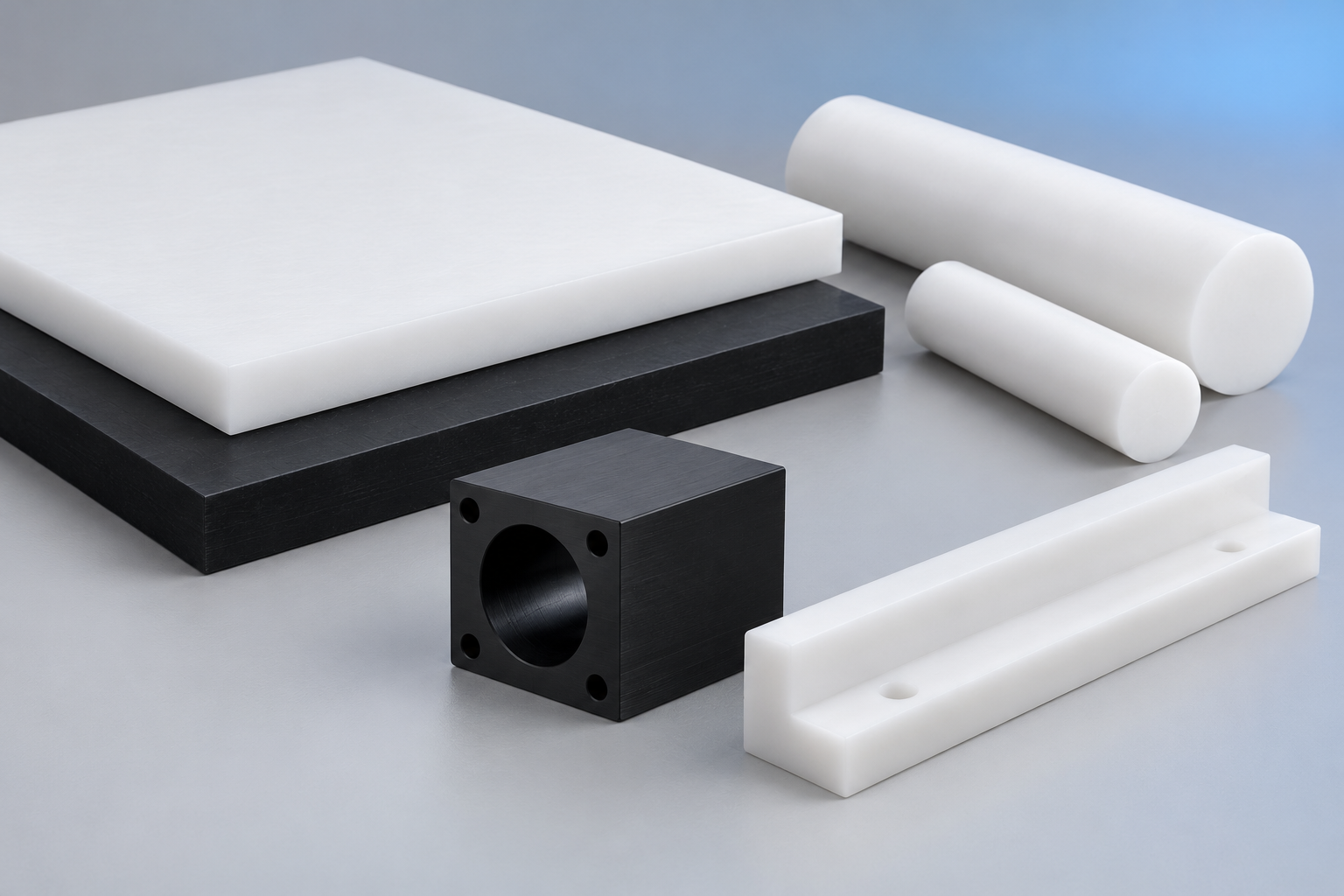
HDPE stands for high-density polyethylene. This lightweight plastic combines toughness, low moisture absorption, and resistance to many chemicals. Common uses include bottles, pipes, sheets, tanks, and machined components.
Heat and constant loads can limit its performance. Choose the grade for the working conditions, not just the material name.
What Is HDPE Plastic?
This thermoplastic belongs to the polyethylene family. Its polymer chains pack closely together, giving it greater stiffness than low-density polyethylene, or LDPE.
A typical stock grade has a density near 0.96 g/cm³, so it is lighter than water. Heat softens the material for molding or extrusion. CNC machines can also cut solid sheet and rod into custom parts.
PE-HD is another name for the same material family. PE300 is a common stock designation, but additives and grade properties can vary. Confirm the exact specification before production.
Main Properties and Limits
- Low weight: Useful for lighter components. Provide enough support to control bending.
- Low moisture absorption: Suits many wet environments, but does not prevent thermal movement.
- Impact toughness: Helps parts withstand knocks. Grade, temperature, and shape affect the result.
- Chemical resistance: Check the fluid, concentration, temperature, and contact time.
- Electrical insulation: Standard grades resist electric current. Static control may require a special grade.
The material can creep, or slowly change shape, under constant load. Review bolt pressure, bearing areas, and support points. A short load test does not prove long-term performance.
What Is HDPE Used For?
Containers: Blow molding produces hollow bottles and containers. Select a grade suited to the contents and handling conditions.
Pipes: Pressure service requires specified pipe grades and approved joining methods. General-purpose stock is not an automatic substitute.
Sheets: Fabricators use sheet for guards, panels, liners, and tank components. Large panels may need ribs or supports.
Machined parts: Common examples include spacers, guides, fixtures, and low-load blocks. Custom geometry does not always require molding tools.
Comparing Similar Plastics
Choose the material that meets the main design need:
- HDPE: Toughness, low moisture uptake, and practical fabrication options.
- LDPE: Greater flexibility, usually with lower stiffness.
- UHMW-PE: A candidate for demanding sliding and wear applications.
- Acetal / POM: A candidate for stiff mechanical parts and accurate fits.
Check chemical exposure, load, temperature, and cost before deciding. Similar-looking stock can behave differently in service.
Machining: Control Heat and Movement
Sharp tools and clear chip paths help avoid rubbing and heat buildup. Cutting settings must suit the tool and part shape; no single speed works for every job.
Clamping also matters. Excess force can bend the stock while the cutter makes a surface. The part may spring back when the clamp releases. Support thin sections without forcing them flat.
Removing material can release internal stress. Deep pockets or heavy cutting on one side may cause movement. Staged cuts and intermediate checks can help manage that risk.
For a custom component, Xproto’s CNC machining services provide a starting point for reviewing the drawing, stock, and critical features.
Why Temperature Changes a Precision Fit
Machine positioning accuracy does not guarantee a stable plastic part. Consider a 100 mm length, a 20°C temperature change, and an assumed expansion coefficient of 180 × 10⁻⁶/°C.
Estimated length change: 100 × 180 × 10⁻⁶ × 20 = 0.36 mm.
This illustrates the issue; it is not a universal grade specification. Agree on inspection temperature and support conditions when a fit is critical. A warm, clamped part may measure differently from a cool, free part.
Choosing a Grade and Joining Method
For outdoor use, select a UV-stabilized grade. Color alone does not prove weather resistance. For food contact, request documents for the exact grade and intended use. Not every stock product has the same suitability.
Ordinary adhesives often bond poorly to this low-energy surface. Suitable plastic welding or mechanical fasteners may work better. Test any adhesive joint before relying on it.
The melting point is not a safe working-temperature rating. Loaded parts can lose stiffness well before melting. Use grade-specific service data.
Häufig gestellte Fragen
Is HDPE waterproof?
It absorbs very little moisture. Leak resistance still depends on seals, joints, and assembly design.
Is it recyclable?
Resin code 2 identifies this plastic. Recycling access depends on local collection rules, contamination, and product type.
Can it hold tight tolerances?
Some features can, but thermal expansion, creep, and clamping distortion need review. Define the fit and inspection conditions rather than assuming metal-like stability.
What should a drawing specify?
Include grade, dimensions, tolerances, loads, temperature, chemical exposure, finish, and any contact requirements. These details help turn a material choice into a usable part.
Key Takeaway
HDPE is useful when toughness, low weight, and moisture resistance matter. Successful parts also account for heat, support, joining, and long-term loads. Select the grade first, then define how the part will work and how to inspect it.