

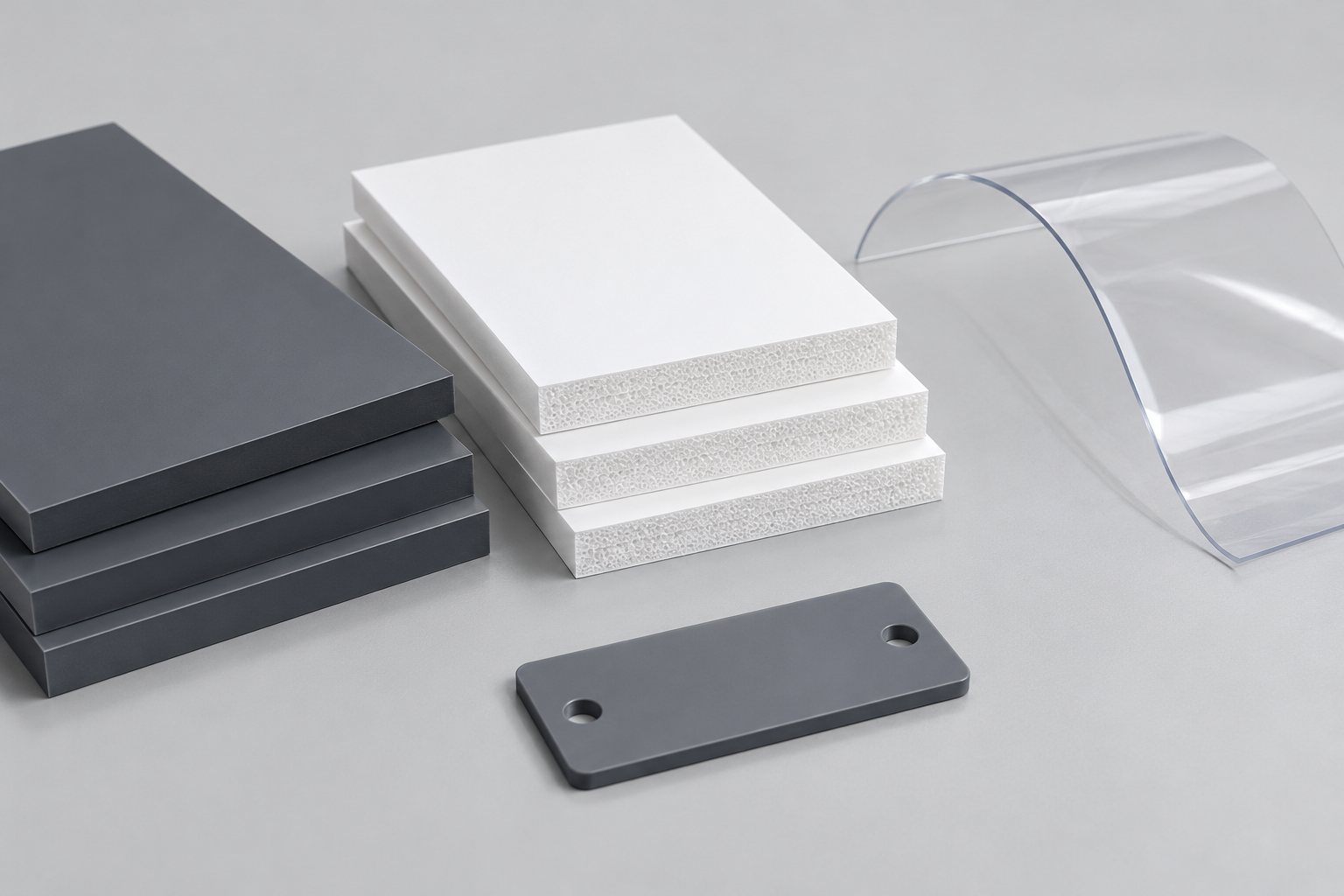
A PVC sheet is a flat plastic material made from polyvinyl chloride. Depending on its formulation and structure, it can be a dense rigid panel, a lightweight foam board, or a flexible sheet.
These products are not interchangeable. A sign board, a chemical-equipment panel, and a flexible curtain can all use PVC, yet need different grades. This guide explains the main types, how to choose thickness, and how to cut or machine the material.
Image: illustrative PVC material types; appearance alone does not confirm a grade.
What Are PVC Sheets Made Of?
PVC is a thermoplastic. Manufacturers combine the base polymer with stabilizers and other additives to obtain the required properties. Plasticizers make flexible grades softer; rigid unplasticized material is commonly called PVC-U or uPVC.
The product name alone does not define strength, weather resistance, fire performance, or contact suitability. Check the specific grade and construction before choosing stock.
Rigid, Foam, and Flexible: Which Type Do You Need?
Solid Rigid PVC
Dense, non-foamed sheet offers stiffness, low moisture absorption, and useful chemical resistance. Typical applications include equipment panels, fabricated tank components, electrical parts, and machined plates.
Choose this category when the design needs a solid section. Chemical resistance still depends on the fluid, concentration, temperature, and stress. Do not treat a general material description as approval for a process tank.
Expanded or Foam PVC Board
Expanded PVC has a cellular structure that reduces weight. It is common in signs, display panels, models, and selected cabinetry or trim applications.
The cut edge can reveal the foam core. Density and surface construction affect edge appearance and fastener holding. A thicker foam board does not automatically replace a thinner solid sheet in a loaded part.
Flexible Sheet
Flexible grades suit applications that require bending rather than a stiff panel, such as suitable curtain and protective-cover products. They behave differently during cutting, fastening, and service.
Clear appearance does not identify the material type. Verify the specification instead of assuming every transparent plastic sheet is PVC or has the same properties.
What Is PVC Sheet Used For?
- Signs and displays: Foam board provides a light substrate for suitable printing, lettering, and fabrication.
- Equipment components: Solid stock can form covers, panels, spacers, and custom profiles.
- Chemical installations: Selected rigid grades suit compatible fluids and fabrication methods.
- Building and trim products: Purpose-made grades can provide moisture-resistant panels and details.
Decorative marble-look panels may include coatings, films, or other layers. Evaluate the complete product, not just the PVC backing. Surface finish, backing construction, and installation requirements matter.
How to Choose Thickness and Sheet Size
There is no universal best thickness. Start with the load, unsupported span, support spacing, and fixing method. Also consider whether a panel must remain flat or only maintain its appearance.
A small display with a backing needs different support from a freestanding panel. A machined plate with a deep pocket needs enough material beneath that pocket. Thickness cannot compensate for an unsuitable grade.
A 4 × 8 PVC sheet usually refers to a nominal 48 × 96 inch format, about 1,219 × 2,438 mm. Confirm the supplier’s actual dimensions, thickness tolerance, and usable area. Metric stock sizes may differ.
For cut parts, allow for the cutting kerf, edge trimming, and workholding. Plan the layout from the finished part drawing rather than assuming the entire sheet becomes usable components.
How to Cut PVC Sheet
Choose the method for the grade, thickness, geometry, and edge quality. Follow the sheet maker’s fabrication guide and the tool manufacturer’s instructions. Secure the work and use suitable eye protection and dust control.
Knife Cutting
Some thin foam boards permit knife cutting. This does not apply to every thickness or to solid rigid stock. Do not force a blade through material outside its approved cutting range.
Saw Cutting
Suitable saws and plastic-cutting blades can produce straight cuts. Support the sheet near the cut to reduce vibration and edge damage. Tool selection and cutting conditions should match the material.
CNC Routing and Milling
Routing suits shaped outlines and repeated cutouts. Milling can add pockets, slots, and accurate features to suitable stock. Sharp tools, chip removal, and controlled clamping help avoid heat buildup and distortion.
Do not use a standard laser cutter on PVC. Laser processing can release hazardous gases and damage equipment. Use an appropriate mechanical cutting method instead; ordinary ventilation does not make an unsuitable laser process acceptable.
Drilling, Bonding, and Finishing
Support thin sheet during drilling, leave adequate material around holes, and avoid overtightening fasteners. Foam cores can compress under concentrated loads, so evaluate washers, inserts, and backing supports for the design.
For bonding, match the adhesive or joining process to the exact grade and surface. Coatings and printed faces can alter adhesion. Test the joint under expected loads and environmental conditions.
Deburr cut edges without removing critical material. If the face will receive paint or print, check surface preparation and coating compatibility first.
Limitations to Check Before Use
- Temperature: Working limits depend on grade and load. Forming temperature is not a continuous-service rating.
- Outdoor exposure: Select a product rated for the intended sunlight and weather conditions.
- Fire performance: Verify the tested grade, thickness, and application. Do not describe all PVC as fireproof.
- Food or water contact: Request documentation for the exact material and intended conditions.
For a different lightweight plastic option, our HDPE material guide explains its properties and limits. Neither material is automatically best for every wet or chemical environment.
Frequently Asked Questions
Is PVC sheet waterproof?
Many grades resist moisture well. A watertight assembly still depends on joints, seals, fasteners, and installation details.
Is foam board the same as solid PVC?
No. Both use the same base polymer, but a cellular core changes weight, stiffness, edge appearance, and fastener behavior.
Can I use it outdoors?
Use a grade intended for the exposure. Check sunlight, heat, fixing details, and thermal movement rather than relying on color alone.
Can it be CNC machined?
Suitable rigid grades can be machined. Define critical fits, surface requirements, stock construction, and inspection conditions before production.
Choosing the Right Material for a Finished Part
Specify the sheet type, grade, thickness, dimensions, tolerances, finish, and working environment. This prevents a lightweight sign substrate from being mistaken for an industrial solid panel.
For custom components, Xproto’s CNC machining services provide a starting point for a drawing-led material and process review.