

Brass Sheet Metal Fabrication: Alloys, Cutting, Bending and Finishes
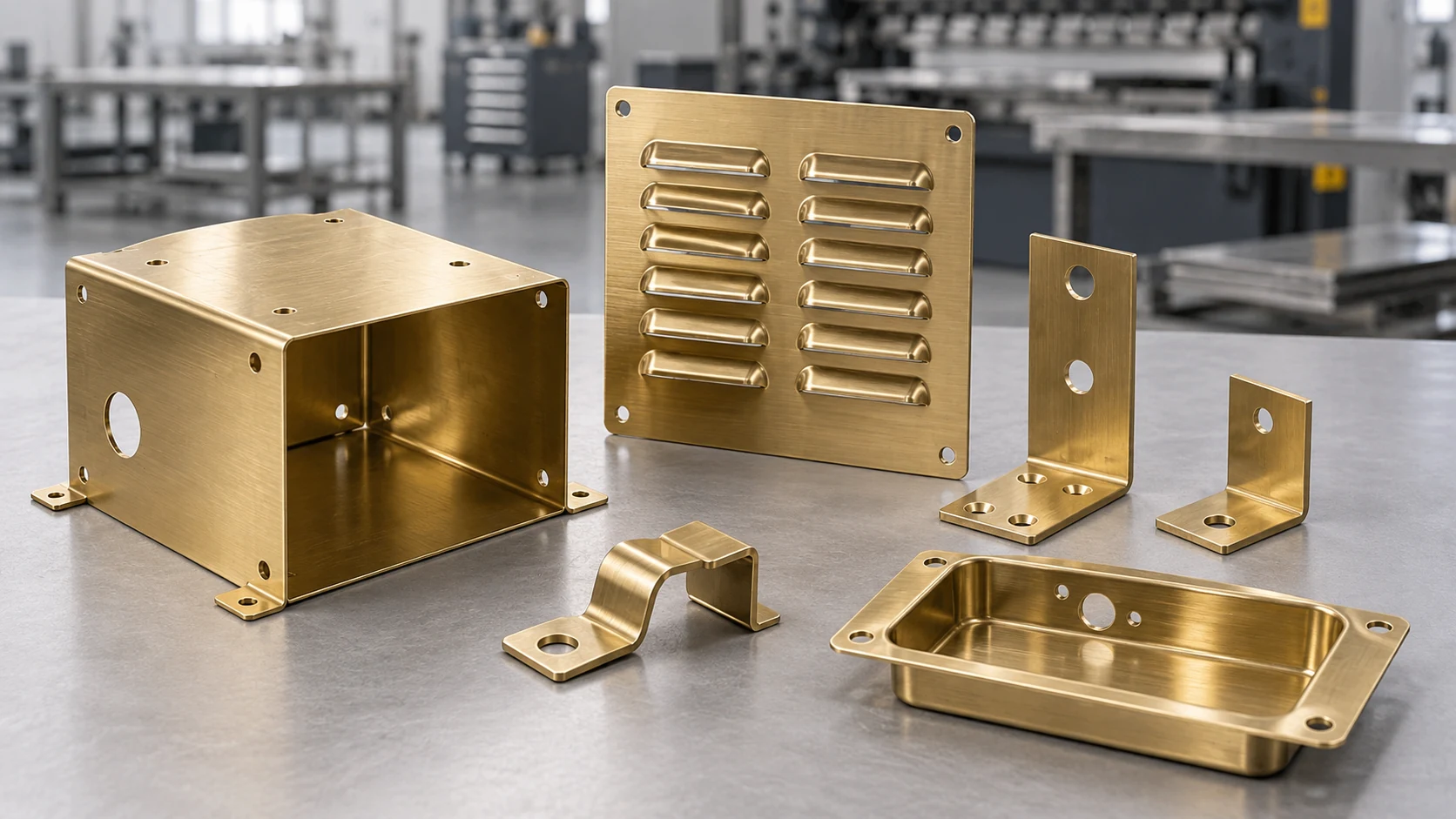
Brass sheet metal combines a distinctive gold-colored appearance with useful formability, corrosion resistance, electrical conductivity and machinability. It is used for electrical contacts, decorative panels, brackets, instrument components, faceplates, hardware and formed enclosures. However, a successful brass part depends on more than choosing a sheet thickness. Alloy, temper, bend direction, grain orientation, surface protection and the fabrication route all affect the result.
This guide explains how brass metal sheets are selected and manufactured, with particular attention to C260 cartridge brass and C268 yellow brass. It also covers laser cutting, punching, bending, joining, finishes and the information a fabricator needs to prepare an accurate quotation.
What Is Brass Sheet Metal?
Brass is a family of copper-zinc alloys. Changing the copper-to-zinc ratio and adding small amounts of other elements changes strength, ductility, color, corrosion behavior and machinability. Sheet and strip are flat-rolled products supplied in specified alloys, thicknesses, widths, surface conditions and tempers.
Designers often choose brass sheet when a part needs a decorative metallic appearance, moderate strength and good cold-forming performance. It can also be suitable for electrical and mechanical components where conductivity, contact behavior or corrosion resistance matters. The exact alloy and temper must match the forming severity and service environment.
Short answer: C260 is a common choice for formed brass sheet parts because it offers excellent cold-work capacity. C268 is another widely used yellow brass for less severe forming and general fabricated components. The drawing should identify the UNS alloy, temper and thickness rather than specifying only “brass.”
Common Brass Sheet Metal Alloys
There is no single universal grade of metal brass sheet. The following comparison is a practical starting point, not a substitute for the material specification or supplier certificate.
| UNS alloy | Common name | Nominal character | Typical reasons to select it | Design notes |
|---|---|---|---|---|
| C26000 | Cartridge brass, 70/30 brass | Approximately 70% copper with zinc as the principal balance | Deep drawing, bending, decorative parts, electrical components and general formed sheet products | Excellent cold-work capacity; temper selection strongly affects formability |
| C26800 | Yellow brass | Lower copper content than C260 | General hardware, decorative components and moderate forming | Confirm bend severity and temper before replacing C260 |
| C28000 | Muntz metal | Approximately 60% copper and 40% zinc | Architectural and heavier-duty sheet or plate applications | Different forming behavior from alpha brasses; verify the intended fabrication route |
| C46400 | Naval brass | Copper-zinc alloy with tin | Selected marine or corrosion-sensitive applications | Do not assume the same forming and joining parameters as C260 |
Why C260 brass sheet is frequently specified
C26000 cartridge brass is an alpha brass known for its strong cold-forming capability. The Copper Development Association lists C26000 as having excellent capacity for cold working and identifies sheet, strip and plate specifications including ASTM B36/B36M. This makes it a logical candidate for bent brackets, drawn shells, clips, covers and decorative components.
The alloy designation alone is not enough. Annealed, quarter-hard, half-hard and harder tempers behave differently. A soft or annealed condition supports severe forming, while a harder rolled temper provides higher strength but less available elongation. The correct choice depends on the final geometry, spring requirement, appearance and manufacturing sequence.
C260 versus C268 brass sheet
C260 is usually preferred when the part requires deeper drawing or more demanding cold work. C268 yellow brass may be economical and suitable for general sheet-metal features, but it should not be treated as an automatic substitute. A change in alloy can affect bend performance, springback, color, conductivity and corrosion behavior. Prototype the actual material and temper when bend margins are small or cosmetic consistency is critical.
Choosing Brass Sheet Temper and Thickness
Temper describes the material condition created by annealing or cold rolling. As cold work increases, strength and hardness generally rise while ductility falls. That tradeoff is central to brass sheet metal fabrication.
| Material condition | Forming behavior | Possible applications | Design caution |
|---|---|---|---|
| Annealed or soft | Best suited to severe bending, drawing and complex forming | Deep-drawn shells, formed covers and complex contours | Lower strength and easier surface marking may require careful handling |
| Quarter-hard | Balances formability and strength | Brackets, clips, faceplates and moderately formed parts | Validate tight radii and features close to bends |
| Half-hard | Higher strength with reduced ductility | Flatter components, resilient brackets and less severe bends | Higher cracking risk at tight radii or unfavorable grain orientation |
| Hard or spring temper | Limited forming capability but high strength | Spring contacts and selected flat or lightly formed features | May require generous bend radii or a different production sequence |
Thickness affects stiffness, weight, cutting time, minimum practical feature size and bend tooling. Avoid converting a gauge callout from memory because brass gauge systems and supplier tables can differ. State the required thickness directly in millimeters or inches and add an applicable tolerance or material standard.
If several thicknesses can meet the load requirement, ask the fabricator which sizes are regularly stocked. A standard stocked thickness can reduce material minimums and shorten lead time. For dimensions and tolerances on the drawing, distinguish the raw-sheet thickness tolerance from the tolerance of fabricated features.
How to Cut Brass Sheet Metal
The best way to cut brass sheet metal depends on thickness, outline complexity, edge requirement, quantity and downstream forming. Production parts may be laser cut, punched, sheared, waterjet cut or machined. Hand tools can work for simple prototypes, but they do not provide the repeatability expected for production assemblies.
Laser cutting
Laser cutting is flexible for prototypes and low-to-medium production quantities because it can produce complex outlines without dedicated blanking tools. Brass is reflective and thermally conductive, so the machine type, wavelength, power and process setup matter. Modern systems designed for non-ferrous materials can process suitable brass thicknesses, but capability varies by shop.
A quotation is influenced by total cutting length, number of pierces, material thickness, small holes, narrow webs and edge-quality requirements. Dense decorative perforations can take much longer than a simple perimeter even when both parts use the same amount of material.
CNC punching and stamping
Punching is efficient for repeated holes, slots, louvers and standard forms. Progressive or compound stamping can become economical at higher volumes when tooling cost can be spread across many parts. The tooling plan should account for grain direction, burr orientation, carrier design and the risk of cosmetic marking.
Shearing and sawing
Shearing is fast for straight cuts and rectangular blanks. It is less suitable for intricate contours, and the cut edge can show rollover, burnish, fracture and burr. Sawing may be used for thicker stock or simple blanks. Edge finishing should be specified when the cut surface is visible or handled by users.
Waterjet cutting
Waterjet cutting avoids a heat-affected zone and can process a broad range of thicknesses. It may be useful when thermal effects are unacceptable or when the shop’s laser capacity does not match the material. Cutting speed, taper, surface striations and abrasive cost must be considered.
Safety note: cutting or grinding brass can create sharp edges, chips, dust and fumes. Use an appropriate industrial process, guarding, extraction and personal protective equipment. The fabrication method should be reviewed against the exact alloy and workplace requirements.
Bending and Forming Brass Sheet Metal
Brass can be press-brake bent, roll formed, stamped, drawn and spun, but the allowable severity changes with alloy and temper. A bend that works in annealed C260 may crack in a harder temper. Use test coupons or prototypes when the design is close to the material’s forming limit.
Inside bend radius
Do not use one minimum bend radius for every brass sheet. The safe radius depends on alloy, temper, thickness, grain direction, tooling and edge condition. Start with a conservative radius and confirm it with the material supplier and fabricator. A larger inside radius generally reduces outer-fiber strain and cracking risk.
Grain direction
Rolled sheet has a grain direction. For critical bends, orienting the bend line across the rolling direction is often more favorable than bending parallel to it, particularly in harder tempers. Grain orientation can conflict with nesting efficiency, so identify truly critical bends on the drawing rather than imposing one orientation on every feature.
Hole and edge distance
Holes, slots and notches located too close to a bend can stretch or distort. The required setback depends on the bend radius, material thickness, die opening and feature shape. If a hole must sit near a bend, the process may need a relief, a later drilling operation or a forming simulation.
Springback and bend allowance
After the press load is removed, brass can recover elastically and change the final angle. Temper and tooling affect this springback. Accurate flat patterns also require a bend allowance or calibrated K-factor that reflects the actual process. Generic CAD defaults are useful for early design, but production values should be verified with the fabricator’s tooling and test bends.
Bend relief and cosmetic surfaces
Bend relief helps prevent tearing and uncontrolled deformation where a bend meets an edge. Decorative brass also scratches easily, so indicate the visible face, acceptable grain or polish direction, protective-film requirement and any areas where tool marks are not allowed.
Design Guidelines for Brass Sheet Parts
- Specify the UNS alloy, temper, thickness and governing material standard.
- Use consistent inside radii when the design allows one press-brake setup.
- Provide adequate flange length for the selected tooling.
- Keep holes and slots away from bend deformation zones where possible.
- Add bend relief to corners and short return flanges.
- Identify grain-sensitive bends and decorative surfaces on the drawing.
- Avoid unnecessarily small holes or narrow webs relative to material thickness.
- Allow access for hardware installation, welding, polishing and inspection.
- Use measurable cosmetic acceptance criteria instead of “perfect finish.”
- Prototype high-risk bends, drawn forms and visible assemblies in the intended production temper.
These principles apply to many fabricated metals, but the values must be adapted to brass. For a broader view of cutting, forming and assembly routes, see Xproto’s custom sheet metal fabrication service.
Joining Brass Sheet Metal
Joining options include mechanical fasteners, clinching, riveting, soldering, brazing and selected welding processes. The best method depends on strength, temperature, electrical performance, appearance, service environment and whether the assembly must be removable.
Soldering and brazing
C260 is rated favorably for soldering and brazing by the Copper Development Association. These processes can be practical for electrical assemblies, decorative work and joints where a filler metal is appropriate. Joint clearance, surface preparation, flux selection and post-cleaning are important. Heat can discolor visible surfaces or soften cold-worked material locally.
Welding
Welding brass requires process-specific expertise because zinc can vaporize under excessive heat. Distortion, porosity, fume control and color mismatch also require attention. Do not copy parameters from steel or copper. A fabricator should qualify the method for the exact alloy, thickness and joint design.
Mechanical fastening
Screws, rivets, tabs, slots and clinched hardware can reduce thermal distortion. The design must provide installation access and sufficient edge distance. Check compatibility when brass contacts another metal in a wet or corrosive environment, because the material pairing can affect galvanic corrosion risk.
Surface Finishes for Brass Sheet Metal
Brass may be used as-milled, brushed, polished, bead blasted, chemically toned, plated, clear coated or painted. The selected finish changes both appearance and fabrication planning.
| Finish | Purpose | Points to define |
|---|---|---|
| Mill or raw finish | Functional parts where natural surface variation is acceptable | Protective film, scratch limits and acceptable oxidation |
| Brushed | Uniform directional appearance | Grain direction, grit or reference sample and visible faces |
| Mechanical polish | Bright decorative surface | Target appearance, edge treatment and handling protection |
| Chemical patina or antique finish | Aged or darkened appearance | Approved sample, color range and sealing method |
| Clear coating | Slows tarnishing and preserves appearance | Gloss, adhesion, masking and service exposure |
| Plating | Changes appearance or functional surface properties | Plating system, thickness, undercoat, rack marks and masked areas |
Natural brass changes color over time as it reacts with the environment. If a stable cosmetic finish is required, state the expected appearance, exposure and maintenance conditions. A physical control sample is often more useful than a subjective color description.
Brass Sheet Metal Tolerances and Inspection
Do not apply one tight tolerance to every feature. Flat laser-cut dimensions, formed angles, hole positions across bends and welded assembly dimensions have different process capability. Critical-to-function dimensions should be tied to clear datums and measured in a defined condition.
Inspection may include thickness verification, incoming material certification, first-article dimensional checks, angle measurement, fixture checks, coating inspection and visual review. Decorative parts need agreed lighting, viewing distance, surface zone and defect limits. If surface texture is functionally controlled, use a measurable requirement and consult a surface roughness chart rather than relying on words such as “smooth.”
What Drives Brass Sheet Metal Fabrication Cost?
Brass is generally more expensive than common carbon steel, so sheet utilization and scrap control matter. The largest cost drivers typically include alloy and temper availability, thickness, nesting yield, cutting length, pierce count, bend count, forming risk, polishing, protective handling, inspection and order quantity.
A decorative brass enclosure can cost more than a similar steel part because fingerprints, scratches, grain direction and color consistency require extra handling. Deep-drawn parts may need tooling and multiple forming stages. For a detailed estimating framework, review Xproto’s sheet metal fabrication cost guide.
Brass Sheet Metal RFQ Checklist
Send the following information to receive a useful manufacturing review and quotation:
- 3D CAD model in STEP or another neutral engineering format.
- 2D drawing with revision, datums, tolerances and critical dimensions.
- UNS alloy such as C26000, required temper and thickness.
- Applicable ASTM, EN, JIS or customer material specification.
- Requested prototype, production and annual quantities.
- Visible surfaces, grain direction, polish direction and defect criteria.
- Finish or coating specification, masking and acceptable contact marks.
- Hardware, joining, electrical and corrosion requirements.
- Material certificates, inspection reports and packaging requirements.
- Delivery destination and required schedule.
If the alloy or temper is still open, explain the functional needs instead of guessing. A fabricator can then compare formability, strength, appearance, stock availability and cost without changing the design intent.
Frequently Asked Questions About Brass Sheet Metal
What is the best brass alloy for sheet metal fabrication?
There is no best alloy for every part. C260 cartridge brass is widely used when cold formability is important. C268 may suit general fabricated components, while specialized alloys may be selected for marine, architectural or electrical requirements. Choose the alloy together with its temper, thickness and finish.
Can brass sheet metal be laser cut?
Yes, suitable brass sheet can be laser cut on equipment configured for reflective non-ferrous metals. Actual thickness capability and edge quality depend on the laser system and process setup. Waterjet, punching, shearing or machining may be better for some geometries and quantities.
How do you cut brass sheet metal without damaging the finish?
Use the appropriate industrial cutting process, protective film when compatible, clean support surfaces and a defined burr-removal method. Mark the cosmetic face and handling requirements on the drawing. The best process depends on thickness, geometry, edge quality and quantity.
Is C260 brass easy to bend?
C260 has excellent cold-work capacity, but bendability still depends on temper, thickness, inside radius, grain direction and edge condition. Annealed and softer tempers tolerate more severe forming than half-hard or hard material. Production bends should be verified with the actual stock and tooling.
Does brass sheet tarnish?
Uncoated brass naturally changes appearance as it reacts with the environment. Polishing can restore brightness, while clear coatings or other finishes can slow tarnishing. Define exposure, desired appearance and maintenance expectations before choosing the finish.
What should a brass sheet drawing specify?
Specify the UNS alloy, temper, thickness, material standard, tolerances, bend radii, grain-sensitive features, cosmetic surfaces, finish, hardware, joining notes and inspection requirements. Include both a 3D model and controlled 2D drawing.
Is brass sheet more expensive to fabricate than steel?
It often has a higher raw-material cost and may need more protective handling for cosmetic parts. The final difference depends on nesting, feature complexity, bends, joining, polishing, finish, quantity and inspection. Compare quotations using the same material and acceptance requirements.
Request a Brass Sheet Metal Manufacturing Review
Send Xproto your CAD model, drawing, alloy or functional requirements, quantity and finish. Our team can review cutting, bend access, grain direction, cosmetic surfaces and inspection needs before quotation.